How to Find Customers of a Company: 5 Sources and a Check
How to find customers of a company from public pages: five sources ranked by proof, a real filing as an example, and a check for each name.
How to find customers of a company comes down to one habit: read the places where the relationship is written down in public. These are the company’s own case studies and customer pages, its annual report if it is listed, the customer’s own pages, and public contract records. Each source proves something different, so keep the link next to every name and check it before your team writes to the account.
Done this way, a list of 50 to 100 named customers for one company takes an afternoon. This guide shows the five sources in order of proof, one real filing that names a customer worth two thirds of a company’s revenue, and a five-point check that keeps partners, prospects and old logos off the list.
Customer, partner or prospect: what counts
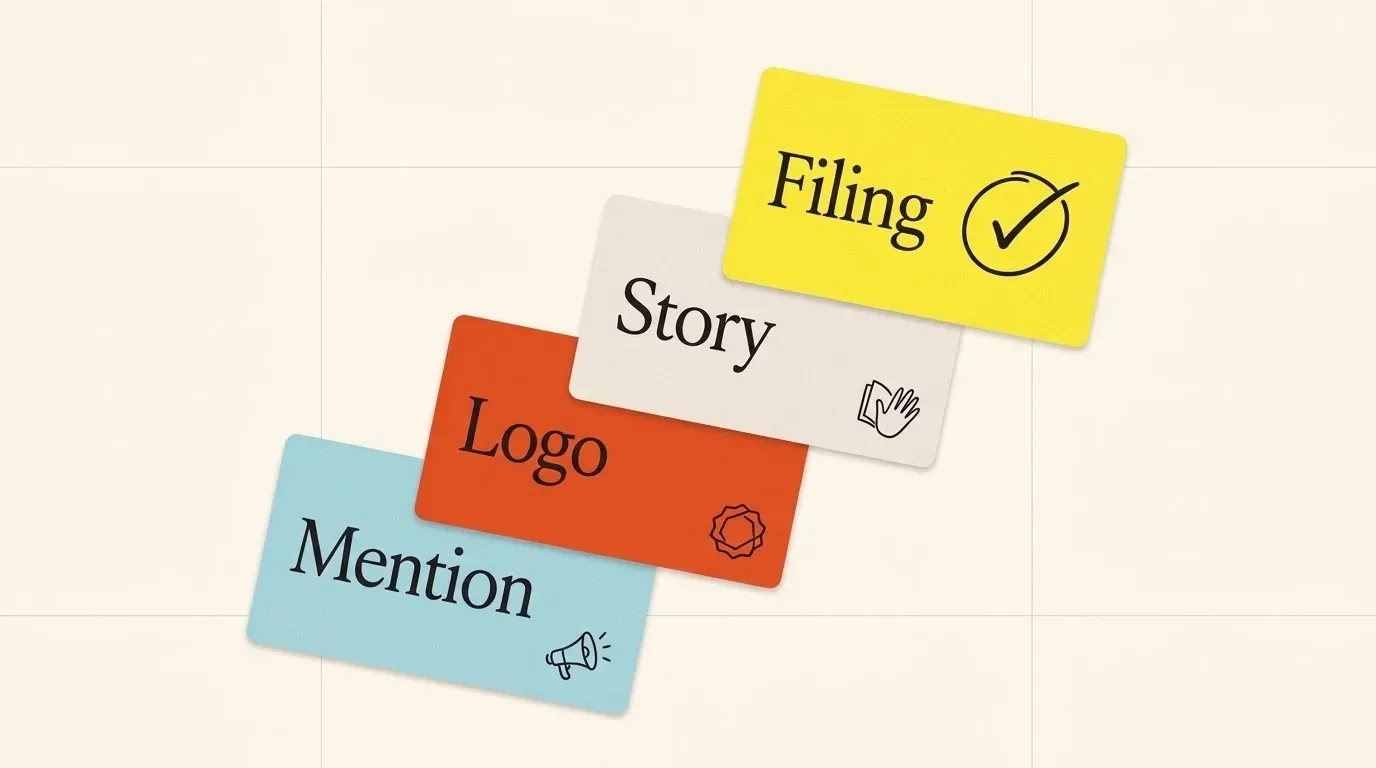
A name on a company’s website is not always a customer. Before you collect names, decide what each kind of name means for your list.
| Kind of name | What it means | Use it for |
|---|---|---|
| Customer | Pays the company for its product or service | Sales lists, look-alike accounts, market sizing |
| Partner | Resells, integrates or co-sells with the company | Channel maps, not sales lists |
| Investor | Owns part of the company | Background only |
| Prospect | Spoke at an event or was in a demo video, but may not have bought | Nothing, until another source confirms it |
| Past customer | Bought once, may have left | Win-back lists, with a date |
The table matters because the sources below mix these kinds on the same page. A “trusted by” strip can hold a reseller’s logo next to a customer’s. A webinar guest can be a prospect. Keep the kind next to the name, and the next sections show where each kind comes from.
1. Start with the company’s own customer pages
Most business-to-business companies publish their best customers. Look in this order:
- Case studies and customer stories. These are the strongest pages on the site. A story names the customer, the team that uses the product and the result, and the customer usually approved the text.
- The customers page. Often at
/customers, with logos and short quotes. A logo is weaker than a story: it can be old, and the customer may have left. - The home page and product pages. Logo strips and quotes sit here too, and they are not always on the customers page.
- Press releases and the blog. Look for “selects”, “chooses”, “rolls out” and “expands with”. A release with a date tells you when the deal started.
Search engines speed this up. The site: operator limits results to one domain (Google Search Central), so site:example.com "case study" and site:example.com "selects" find pages that the site menu hides.
How much does the site alone give? A research firm built a customer list for Lattice, an HR software company, from ten public sources. The customers page gave 59 names, and the home page alone added 11 more, of 132 names in total (Aqute Intelligence). The company’s own site was the largest single source by far.
The limit of this source is that it shows only the customers the company wants to show. For a public company, there is a second document where it must say more.
2. Read the annual report of a public company
US accounting rules make a public company disclose any single customer that brings in 10 percent or more of its revenue. It must state that fact and the amount of revenue, but it “need not disclose the identity of a major customer” (ASC 280-10-50-42, via Deloitte DART). The SEC’s rules for the business section also ask a company to describe any dependence on key customers, including government customers (Regulation S-K, Item 101).
So many filings give a revenue share for “Customer A” without a name. Some name it, often in the risk factors, because losing that customer would hurt the business.
A worked example: CoreWeave
CoreWeave’s annual report for 2025 is a clear case. It says the company “recognized an aggregate of approximately 67% of our revenue from our top customer, Microsoft” in the year ended 31 December 2025 (CoreWeave 10-K, filed 2026-03-02). The same filing names two more customers through their contracts:
| Customer | What the filing says | What it proves |
|---|---|---|
| Microsoft | About 67% of 2025 revenue | Largest customer, by a wide margin |
| OpenAI | Committed to pay up to about $6.5 billion through May 2031 | A long contract, signed |
| Meta | Initially committed to pay up to about $14.2 billion through December 2031 | A long contract, signed |
Three names from one document, each with a revenue share or a contract value. No customer page gives you that.
To find filings like this for other companies, use the SEC’s full-text search. Search the exact phrase "our top customer" or "our largest customer", filtered to form 10-K. Then open the company’s filing and search the page for “customer” and “10%”.
Filings cover only listed companies, and only the largest customers. For everyone else, look at the relationship from the other side.
3. Look from the customer’s side
A customer also leaves public traces of the products it buys. These are good proof, because the customer wrote them, not the seller.
- Job posts. A post that asks for “3 years of experience with Workday” says the company runs Workday, or plans to. Search
"<product>" site:<customer>.comand the customer’s careers page. - The customer’s own blog and engineering talks. Teams write about the tools they moved to, and they talk about them at conferences.
- Vendor and partner pages. Some companies, mostly in health care, government and large manufacturing, publish their supplier lists or approved vendors.
- Review sites. A review can name the reviewer’s company. More often it gives only the industry and the company size, so treat it as a hint.
This source is slow for one seller with many customers, but it is the best way to test a single name. If a seller’s logo strip shows a bank, and that bank’s job posts ask for the seller’s product, the name passes.
4. Follow public money
Governments publish what they buy. In the United States, USAspending.gov lists federal contract awards by recipient, so you can search a company’s name and see which agencies pay it and how much. Many states and cities publish their contracts in the same way, and the EU publishes tenders and awards on TED.
Two rules help here:
- Search the company’s legal name, not its brand. Contracts go to the legal entity.
- Count each agency as its own buyer for sales work. For the 10 percent rule above, the accounting rules count “the federal government” as one customer (Deloitte DART), which is why a filing can give one revenue share for “the U.S. government” with no agency names.
5. Search the web for both names together
The last source is a set of searches that find pages where the two companies appear together:
"<company>" "case study" -site:<company>.comfinds stories that partners and media wrote."<customer>" "<company>" selects OR chooses OR deploysfinds press coverage of a deal."<company>" customeron news sites finds named deals that the company did not post.
These pages are often secondary: a news story that repeats a press release, or a partner page that lists shared customers. They are good leads. Before you use one, find the primary page behind it.
Check each name before you use it
A long list is easy. A list your team can trust needs one check per name.
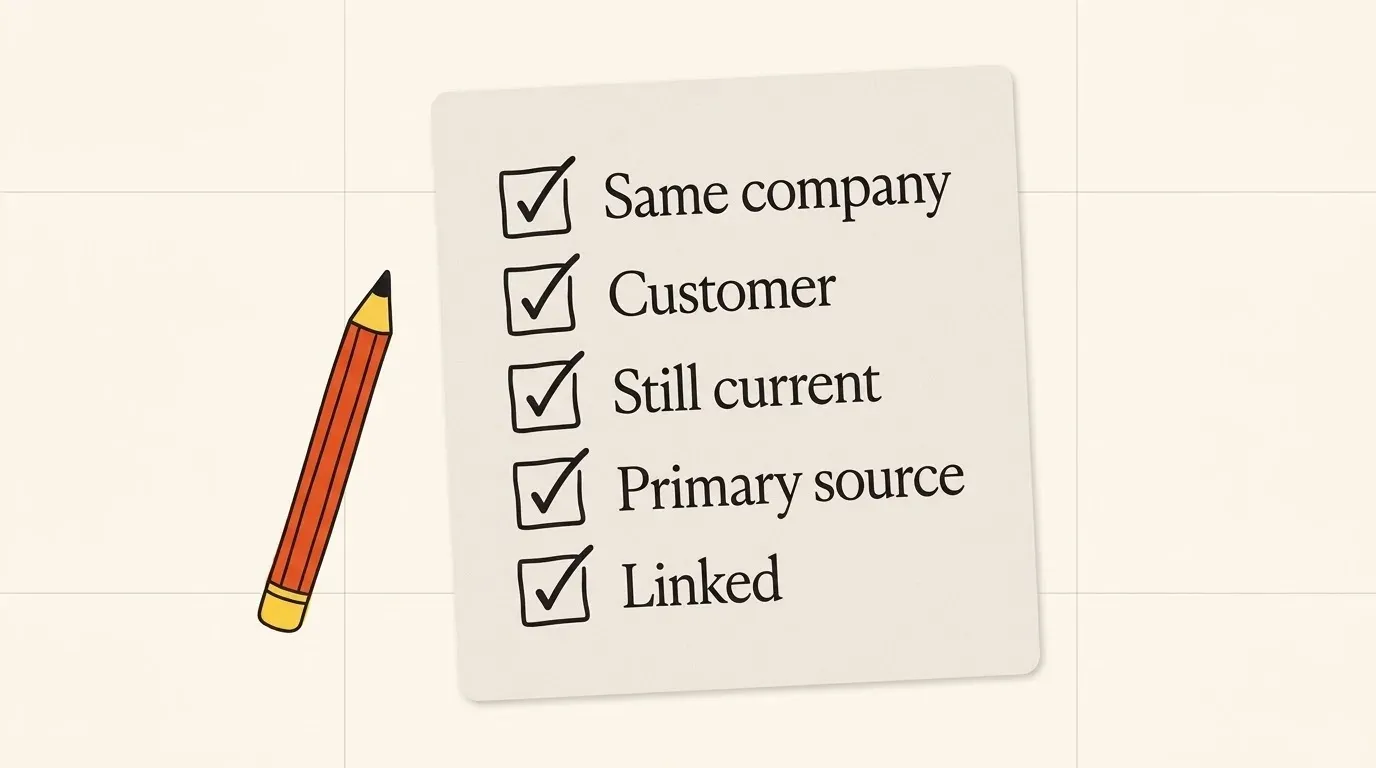
A name stays on the customer list when it passes all five:
- Same company. The name and the domain point to the company the page means. Delta the airline and Delta the faucet maker are not the same account. Open the domain and read the home page.
- Customer, not partner. The page says the company buys or uses the product. “Integrates with”, “resells” and “powered by” are partner words.
- Still current. The page has a date in the last two to three years, or the logo is still on the live customers page. Older names go to a past-customer list with their date.
- Primary source. The link goes to a page that the seller, the customer or a regulator wrote, not to a copy of it.
- Linked. The link is saved next to the name, so anyone can check it in ten seconds.
| Source | What it proves | Strength | How fast it gets old |
|---|---|---|---|
| Annual report | Revenue share or contract value | Strongest | Yearly; read the latest filing |
| Case study | The customer uses the product, with a named team | Strong | Slowly; check the date |
| Contract record | A signed public contract | Strong | Ends on the contract end date |
| Customer’s job post | The customer runs the product | Medium | Months |
| Logo on the site | The customer agreed to be shown, at some point | Medium to weak | Can stay years after a customer leaves |
| News or partner page | Someone reported a deal | Weak until you find the primary page | Varies |
The check also gives your first message something true to say. “I read how your platform team moved to X in 2025” opens a better call than a guess, and it is true because you read the page.
Get customer lists for many companies at once
The five sources work well for one company. For 200 competitors’ customers, or for an AI agent that needs the answer during a call, a manual search is too slow.
Innerfetch API returns the customers of a company domain in one request. Each row has:
- the customer’s name and a verified domain,
- the link to the public page that names the relationship, and a quote when there is one,
- the number of public sources that name the same customer,
- a short card with industry, size and country.
It is one option among others. A research firm or your own team is a better fit when you need customers that no public page names. To use the API:
- Read the Customers API page and its sample answer.
- Follow the guide to find your competitors’ customers. It runs the full job in four calls.
- Connect an AI agent through the MCP server, if you do not want to write code.
- Read the credit cost of a customer row on the pricing page.
Use the check above on the rows you plan to act on. Each row has its link, so the check takes seconds per name.
Questions people ask
Can I find the customers of a private company?
Yes, with sources 1, 3, 4 and 5. A private company does not file an annual report, but it still publishes case studies, and its customers still post jobs and sign public contracts. Expect a shorter list than for a public company of the same size.
Why does a 10-K say “Customer A” instead of a name?
The accounting rule requires the revenue share, not the name. Many companies keep the name private for commercial reasons. Search the rest of the filing, the risk factors and the company’s press releases: the name is often public in another place.
Are a company’s customers a good list of my prospects?
When the company is your competitor, yes: those accounts already pay to solve your problem. Our guide to finding competitors shows how to build that competitor list first. Check the dates, because an account that left a competitor last year can be the warmest one on the list.
Is it legal to collect customer names from public pages?
Company names on public pages are business facts that the seller or the customer chose to publish. Rules on people’s data are stricter. If you add names of people, read the privacy rules that apply to you before you store or contact them.
A checklist to start today
- Write down why you need the list: sales, market size or a check on a vendor.
- Read the company’s case studies, customers page, home page and press releases.
- If the company is listed, search its latest annual report for “customer” and “10%”.
- Search contract records under the company’s legal name.
- Run the three web searches from source 5 and find the primary page for each result.
- Mark each name as customer, partner, prospect or past customer.
- Run the five checks and save one link per customer.
- Put a date on the list, and run it again next quarter.
A customer list without links starts arguments in the next pipeline review. A list with links lets your team start writing.
Try it on a company you know
Start with 200 free credits. Sign up with a work e-mail.